



PEEK and PTFE are both high-performance polymers. They both operate at similar maximum temperatures, but how they perform under load and under specific applications differ significantly.
This guide covers all the differences between PEEK and PTFE so you can make the right choice.
Quick Comparison Table
| Specification | PEEK | PTFE | Preferred Material |
| Chemical resistance | Affected by concentrated sulfuric and nitric acid | It’s resistant to nearly every chemical | PTFE |
| Temperature resistance | Higher melting point of 644 degrees Fahrenheit; doesn’t deform under high temperatures | Melting point of 620 degrees Fahrenheit, but deforms under constant high temperature | PEEK |
| Tensile strength | Tensile strength – 90 to 100 Mpa; Stiffness – 3.9 GPa | Tensile strength – 25 to 35 Mpa; Stiffness – 0.495 GPa | PEEK |
| Slip resistance | Coefficient of friction – 0.15 to 0.45 | Coefficient of friction – 0.04 to 0.1; almost as slick as wet ice on wet ice | PTFE |
| Electrical insulation | Dielectric strength – 50 kV/mm; used in high heat-producing electronic devices | Dielectric strength – 50 to 150 kV/mm; used to coat wires and circuit boards | PTFE |
What Is PEEK?

PEEK (Polyether Ether Ketone) is a very strong plastic that’s commonly used in aerospace, medical equipment, and electronics. It’s actually classified as a super engineering plastic.
Because of its strength, PEEK is widely used in structural and wear components like aircraft fairings, automobile engine parts, spinal fusion cages in medical equipment, and industrial pumps.
For more information, check out our guide to PTFE.
What Is PTFE?
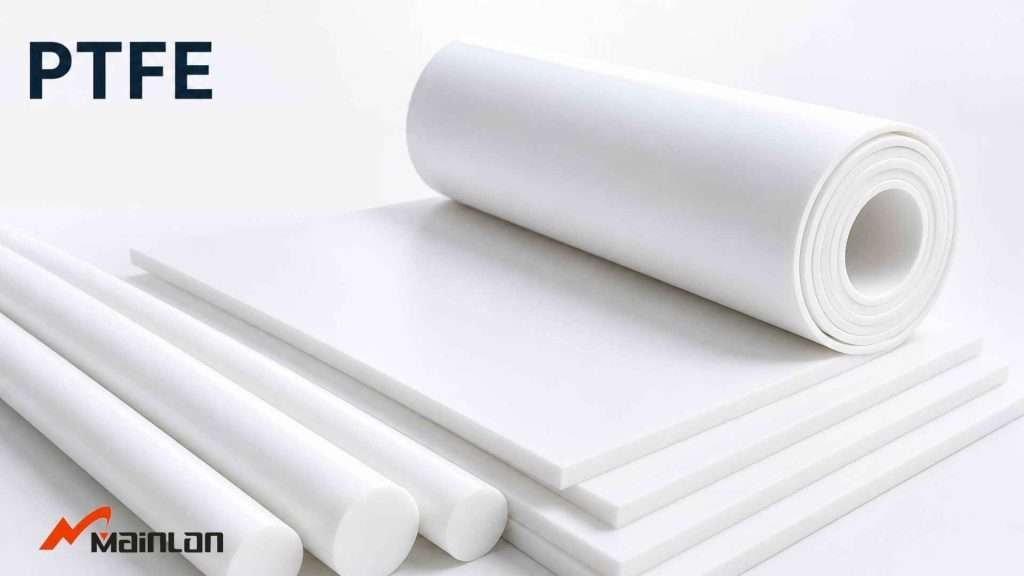
Polytetrafluoroethylene (PTFE) is a tough plastic material that resists heat, chemicals, and stains exceptionally well. It isn’t as durable as PEEK, but it’s more affordable, resists chemical much better, and is non-stick. That’s why it’s very common in both everyday items and industries.
When it comes to industries, it’s widely used as seals, insulation, and for lubrication.
You can also find it in everyday items like non-stick pans, wires, and even in waterproof clothing. PTFE is commonly known by the brand name Teflon.
PEEK vs. PTFE: What’s the Difference?
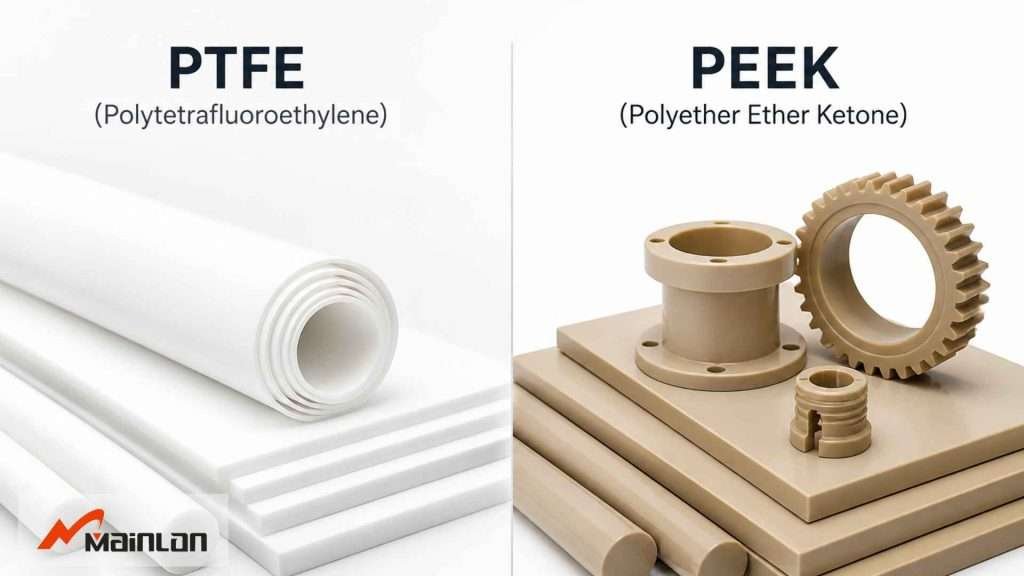
PEEK and PTFE have different uses, but here’s how they differ in their properties.
Chemical Resistance
Winner: PTFE
PTFE is the most chemically resistant of nearly all plastics. It resists almost all chemicals, including acids, bases, and solvents. That’s why it’s used in harsh chemical processing and as seals and gaskets.
PEEK also resists chemicals well, but its affected by concentrated sulfuric acid or concentrated nitric acid. It isn’t as chemically resistant as PTFE, but it’s purpose is different. It has enough chemical resistance so it doesn’t lose its strength even in aggressive chemical environments.
Temperature Resistance
Winner: PEEK
PEEK has a melting point of 644 degrees Fahrenheit (340 degrees Celsius), while PTFE has a melting point of 620 degrees Fahrenheit (327 degrees Celsius). Though they have pretty similar melting points, PEEK can sustain high temperatures for much longer without deforming.
The ability of PEEK to withstand high temperatures without deforming is why it’s used in aerospace engine components, high-temp electrical insulators, and automotive engine parts.
Tensile Strength
Winner: PEEK
PEEK is much stronger and more stable compared to PTFE. Its strength is comparable to that of aluminum or stainless steel.
There are only a few polymers that are stronger than PEEK. That’s why PEEK is used in aerospace, automotive engine components, and medical implants, where metal-like durability is required, but metal can’t be used.
PEEK has a tensile strength of 90 to 100 MPa, which is significantly higher compared to PTFE’s strength of 25 to 35 MPa.
PEEK is also much stiffer at 3,900 MPa compared to PTFE’s 495 MPa.
Slip Resistance
Winner: PTFE
PTFE’s coefficient of friction is 0.04 to 0.1, which is amongst the lowest of all solid materials. It’s almost as slick as wet ice on wet ice and maintains it even in high temperatures. That’s why it’s commonly used in non-stick pans.
PEEK’s coefficient of friction ranges from 0.15 to 0.45. It’s also non-stick, but for industrial uses where more lubrication is required, PTFE is preferred.
For non-stick pans, PEEK is actually a high-performance alternative to PTFE. It’s almost as non-stick as PTFE for cooking while resisting scratches and lasting longer.
Electrical Insulation
Winner: PTFE
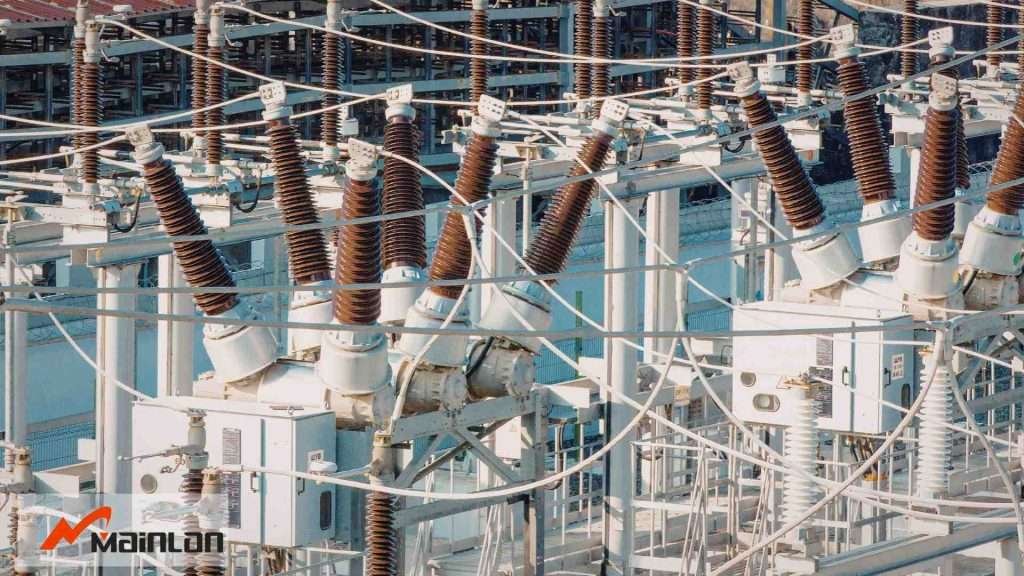
PTFE is a better chemical insulator compared to PEEK. It has a higher dielectric strength of 50 to 150 kV/mm compared to PEEK’s 50 kV/mm.
To put it into perspective, even a 1mm thick PTFE sheet can withstand around 170,000 volts. That’s why it’s used to coat wires, circuit boards, and transformers.
PEEK is also a great insulator, but its use case is different. It’s commonly used in electronic devices that consistently generate high heat like surgical instruments.
FAQs
Why is PEEK more expensive than PTFE?
PEEK is significantly more expensive compared to PTFE as it’s a more complex polymer. It takes more time to manufacture, and it’s usually not produced in as large quantities as PTFE.
Is PEEK stronger than PTFE?
Yes, PEEK (90 to 100 MPa) is significantly stronger compared to PTFE (25 to 35 MPa). It maintains its shape under heavy loads and high temperatures, so it’s used in applications where metal-like durability is required but metal can’t be used.
What temperature can PEEK and PTFE handle?
PEEK has a melting point of 644 degrees Fahrenheit, while PTFE has a melting point of 620 degrees Fahrenheit. They have a pretty similar melting point, but PEEK can sustain higher temperatures much longer without deforming.
Which resists chemicals better?
PTFE is more chemically resistant than PEEK. It resists almost all chemicals, including acids, bases, and solvents. PEEK also resists chemicals, but it’s affected by concentrated sulfuric and concentrated nitric acid.
Which is better for use in automobiles and aerospace?
Both have different uses in automobiles and aerospace. PEEK is better for structural and load-bearing parts like engine components and aircraft fairings. PTFE is ideal for bearings, seals, fuel line gaskets, and insulation systems.
The Final Word
PEEK and PTFE are both commonly used in industries. However, PEEK is better for applications that require higher strength. If you need something that can resist higher loads without deforming, PEEK should be your choice. It’s more expensive, though.
PTFE is highly suitable for applications that require low friction coefficients and self-lubricating properties.. It’s almost as slick as wet ice on wet ice, so it doesn’t require any lubrication and also resists chemicals, heat, and stains exceptionally well.
In some cases, you can combine PEEK and PTFE for the best results.
If you’re confused between PEEK and PTFE and want to make the right purchase decision, get in touch with Mainlan. We are among the top-rated suppliers of these high-performance polymers and deliver quickly throughout the United States.
